The G-Shock catalogue is huge, and the model names look like a keyboard fell down the stairs. The good news: a first G-Shock doesn't need to be complicated. It needs to be tough, readable, and cheap enough that you won't wince if it picks up a scratch.
We haven't worn these. This guide is built from Casio's published specs and published comparisons, and we mark what still needs checking. Prices are rough ranges, not quotes.
The short answer
- Cheapest classic: DW-5600UE-1 (the square).
- Best "set it and forget it": GW-M5610U-1 (the square with solar power and radio time sync).
- Best looking for many people: GA-2100-1A1 (the octagon with hands).
- Best if you want a phone link: GA-B2100-1A (solar octagon with Bluetooth).
For a deeper look at the square family (including the Bluetooth GW-B5600), see Your first G-Shock square. For the octagon family, including the metal GM-2100, see the CasiOak guide.
Yes, a Bluetooth G-Shock exists. Casio lists it with "Smartphone Link" (Bluetooth). It is still a G-Shock, not a smartwatch, and we won't hold it against you. Check the Casio Watches app for the current feature list.
Specs at a glance
Specs come from Casio's official product pages, official news releases and official operation guides. Module numbers for solar models are from the official manuals (the product pages we read do not show a module number).
| Spec | DW-5600UE-1 | GW-M5610U-1 | GA-2100-1A1 | GA-B2100-1A |
|---|---|---|---|---|
| Case size (L × W × H) | 48.9 × 42.8 × 13.4 mm | 46.7 × 43.2 × 12.7 mm | 48.5 × 45.4 × 11.8 mm | 48.5 × 45.4 × 11.9 mm |
| Weight | 52 g | 52 g | 51 g | 52 g |
| Water resistance | 200 m (20 bar) | 200 m (20 bar) | 200 m (20 bar) | 200 m (20 bar) |
| Power | CR2016, ~5 years | Tough Solar (rechargeable) | 2 × SR726W, ~3 years | Tough Solar (rechargeable) |
| Module | 3525 | 3495 | 5611 | 5689 |
| Light | LED backlight (Super Illuminator), afterglow | LED, 1.5 or 3 s, afterglow, white | Double LED (face and display) | Double LED (face and display) |
| Display | Digital | Digital | Analog + digital | Analog + digital |
| Key functions | 1/100 s stopwatch, 24 h countdown timer, alarm, hourly signal, flash alert, full calendar to 2099 | Multi-Band 6, world time 31 zones (48 cities + UTC), stopwatch, 24 h timer, 5 alarms | World time 31 zones, 1/100 s stopwatch, timer, 5 alarms, calendar to 2099, hand shift | Bluetooth link, world time 38 zones, stopwatch, timer, 5 alarms, hand shift |
| Price | Check the current price at the retailer | Check the current price at the retailer | Check the current price at the retailer | Check the current price at the retailer |
Accuracy per Casio: ±15 seconds per month on the DW-5600UE, GW-M5610U and GA-2100 (the GA-B2100 is also listed at ±15 seconds per month when not using the mobile link).
Pick 1: DW-5600UE-1, the classic square
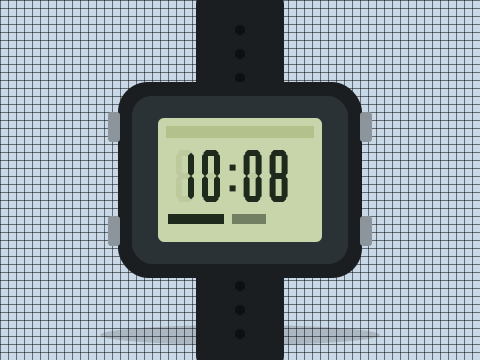
This is the shape most people picture when they hear "G-Shock". Casio's official Europe DW-5600UE-1 page lists 200 m water resistance, a CR2016 battery rated at about 5 years, mineral glass, 48.9 × 42.8 × 13.4 mm and 52 g.
The "UE" is an update of the long-running DW-5600E. Official Operation Guide 3525 confirms a CR2016 rated at about 5 years, accuracy of ±15 seconds a month, an LED backlight (Super Illuminator, afterglow), Flash Alert, and a 24-hour timer. A G-Shock fan site says the older DW-5600E used an EL light, a 2-year rating and module 3229. If you buy a listing that just says "DW-5600", check the caseback.
- Pros: cheapest of the four, simple, easy to read, replaceable coin cell, good tool for a first G-Shock.
- Cons: thickest of the four (13.4 mm), no solar, no time sync, the battery will need a swap eventually.
- Best for: anyone who wants the iconic look without a big spend.
Where to lookOfficial Casio product pages. These are not affiliate links. Check the current price at the retailer.
We are applying to affiliate programmes; see our affiliate disclosure.
Pick 2: GW-M5610U-1, the "forget about it" square
This one charges from light and corrects itself using radio time signals. Casio's official Europe GW-M5610U-1 page lists Tough Solar, Multi-Band 6, mineral glass, 46.7 × 43.2 × 12.7 mm, 52 g, 200 m, about 10 months of runtime in normal use without light after a full charge, and 22 months in power-save mode in the dark, plus an LED of 1.5 or 3 seconds with afterglow, world time of 31 zones (48 cities + UTC), and no Bluetooth.
Be careful with names. Official Watch Operation Guide 3495 is the current GW-M5610U module guide; official Operation Guide 3159 is the older GW-M5610 module (it lists EL illumination, not LED). A G-Shock fan site notes that in the US the GW-M5610U-1 is sometimes sold as "GWM5610-1", and that older 3159 stock may still be around. Confirm the module number on the caseback. Casio's US product.GWM5610-1 page was not found in the 2026-11-27 check, so we do not treat the "GWM5610-1" US name as confirmed.
- Pros: solar, radio-set time, five alarms, a much longer service life between batteries, the classic square shape.
- Cons: the priciest square, radio reception depends on where you live and whether a Multi-Band 6 signal reaches you, and a solar watch needs light. A watch that lives in a drawer won't love that.
- Best for: people who want to set it once and stop thinking about it.
Where to lookOfficial Casio product pages. These are not affiliate links. Check the current price at the retailer.
We are applying to affiliate programmes; see our affiliate disclosure.
Pick 3: GA-2100-1A1, the octagon
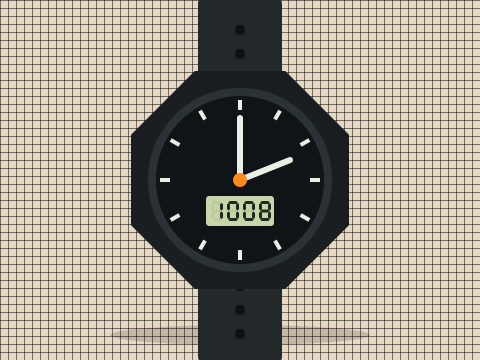
The GA-2100 has hands and a digital window in a slim octagonal case made of carbon-reinforced resin. Casio's official Europe GA-2100-1A1 page lists 48.5 × 45.4 × 11.8 mm, 51 g, mineral glass, 200 m water resistance, about 3 years on two SR726W cells, and world time of 31 zones.
A published comparison from The Wrist Guide points out that the GA-2100 is thinner than the GW-M5610U but longer and wider, and that its digital area is smaller because the face is shared with hands. That's a size fact to check against your wrist, not a verdict.
- Pros: the look many people prefer, thinner profile, analog-digital readability, 5 alarms and world time.
- Cons: no solar and no radio sync, two small batteries rather than one, and a smaller digital readout than the squares.
- Best for: people who prefer hands, or want a G-Shock that looks at home with a shirt.
Where to lookOfficial Casio product pages. These are not affiliate links. Check the current price at the retailer.
We are applying to affiliate programmes; see our affiliate disclosure.
Pick 4: GA-B2100-1A, the solar octagon
Same case shape as the GA-2100, and almost the same official size (48.5 × 45.4 × 11.9 mm and about 52 g in Casio's April 2022 GA-B2100 news release; the GA-2100 is listed 0.1 mm thinner). Official Operation Guide 5689 lists about 7 months of battery operating time after a full charge under stated conditions (including 6 hours of Power Saving a day). Casio's official April 2022 release also lists about 18 months with the power-saving function on after a full charge. The Bluetooth feature is "Smartphone Link" in Casio's copy; check the Casio Watches app for the current feature list.
If you want the octagon without ever opening a battery door, this is the one. It costs more, and the Bluetooth feature means one more thing to set up.
- Pros: octagon look, solar charging, Bluetooth phone link.
- Cons: priciest here, a bit more setup, and one of the few features here that needs your phone.
- Best for: people who want the GA-2100 style plus low maintenance.
How to choose
- Pick a style first. Digital square or analog-digital octagon. Everything else follows.
- Pick your maintenance level. A coin-cell watch is cheap and simple, but a battery swap will come up eventually. Solar models cost more and need light.
- Check your wrist. Compare case size and band range (Casio lists 145-205 mm for the squares) with your wrist before ordering.
- Set a budget. The DW-5600UE is the cheapest. The solar ones cost noticeably more.
What about the 200 m rating?
All four are rated 200 m (20 bar). Distributor FAQs note that this suits swimming and snorkelling, not scuba diving, and that you shouldn't press the buttons under water (check the manual for your model). A good rating on paper still depends on a healthy gasket, so a watch that has had its battery changed should have its seals checked.
FAQ
Which G-Shock is best for a first-timer? The DW-5600UE-1 is the simplest and cheapest. The GW-M5610U-1 is a better fit if you hate batteries. The GA-2100-1A1 is the pick for those who like the octagonal look. For the next step up the square line (Bluetooth, or a full-metal case), see the square guide and the GMW-B5000 guide.
Do I have to replace the battery? The DW-5600UE (CR2016, about 5 years) and GA-2100 (two SR726W, about 3 years) use replaceable batteries. The solar models use a rechargeable cell. Casio specifies runtimes, not lifetime.
Is the GA-B2100 a smartwatch? No. It has a Bluetooth "Smartphone Link" feature, but the listing we read doesn't mention an app store or health sensors, and it is a G-Shock first. Check the Casio Watches app for the current feature list.
Are G-Shocks good for small wrists? The listed cases are 42.8-45.4 mm wide, and they're all around 52 g. That is a sizeable watch for a small wrist. Check the dimensions and lug-to-lug before buying. We'll cover smaller options in a separate guide.
Is G-Shock better than a smartwatch? Different job. A G-Shock tells time, shrugs off knocks, and goes years without a charger. A smartwatch does more, and needs charging. Pick the one that matches your life.
Where do I find the model number? It's printed on the caseback along with the module number. Compare it with the listing to make sure you're getting the version you want.

Nerd Watches Team. We research every guide from published specs, manuals and owner discussions, and we say so when we haven't tested something ourselves. About us